Have you ever sent a message that said, “Sorry, I have to bale on plans,” and later realized it might be wrong? That small spelling mistake can look unprofessional. It can cost marks in exams.
It can even confuse legal meaning in serious situations. Many people search “Bale or bail meaning”, “Is it bail or bale out?”, and “Does bale mean to leave?” because these two words sound exactly the same. They are homophones. But they do not share meaning.
This guide solves that confusion in simple language. You will learn Bale or bail meaning in English, Bale or bail meaning in Urdu, correct pronunciation, grammar roles, and real usage examples. You will also see a search intent table, comparison charts, and expert writing advice.
If you want a quick answer, detailed explanation, and professional clarity in one place, this article gives you all three.
Bale or Bail means
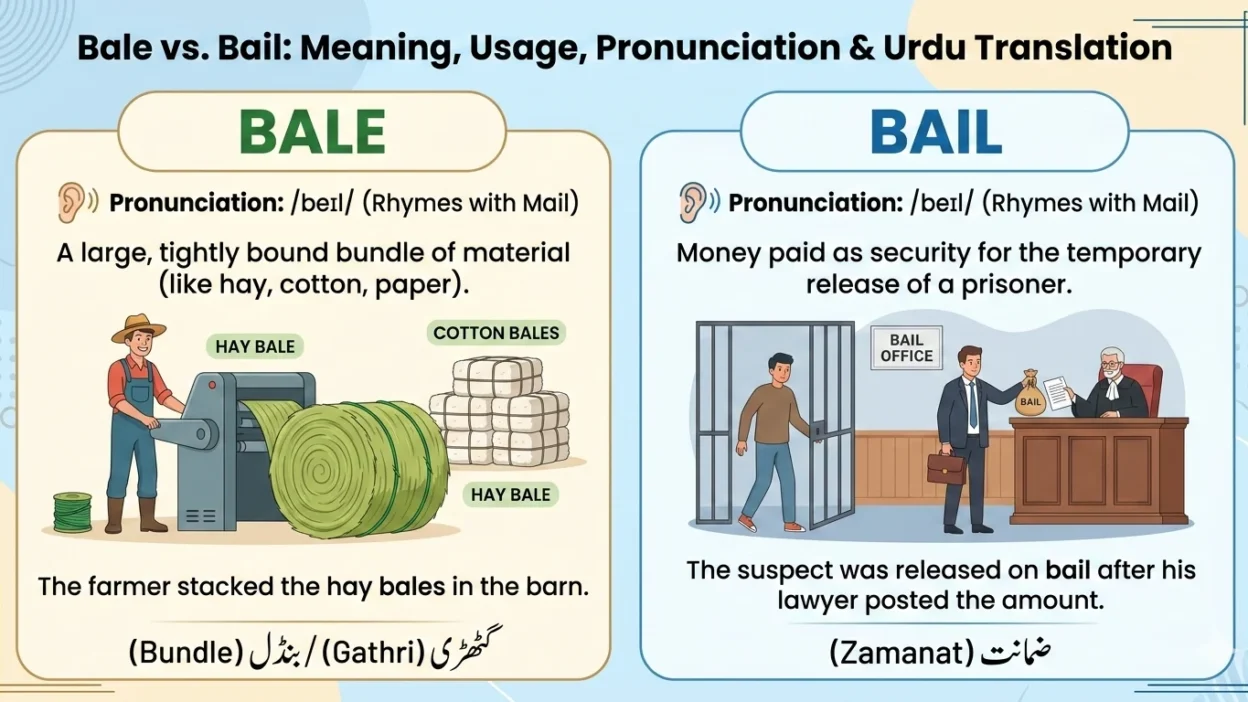
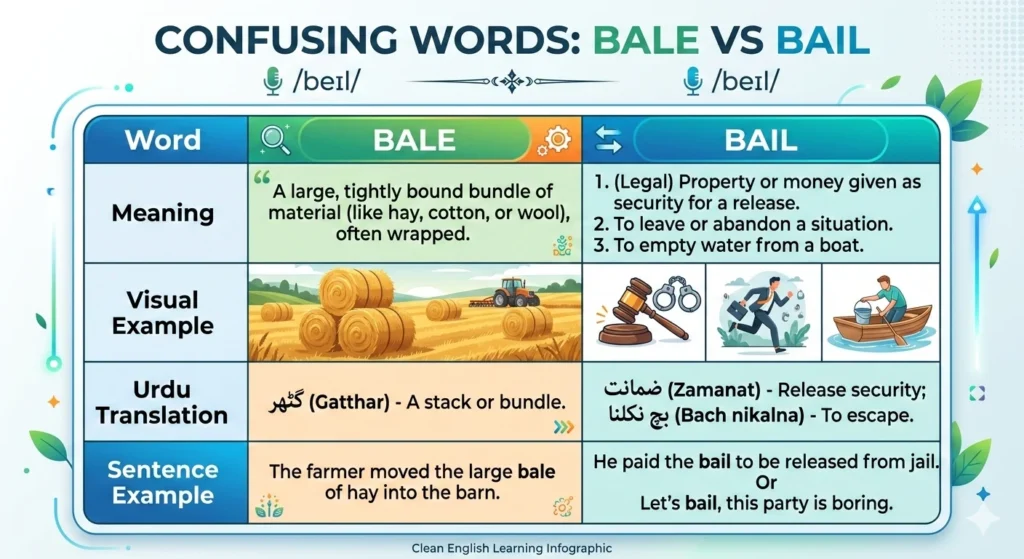
Bail means legal release money or leaving suddenly.
Bale means a tight bundle of goods or removing water from a boat.
Both are pronounced /beɪl/.
Examples
- He paid bail and left jail.
- Don’t bail on plans again.
- The farmer stacked a bale of hay.
- Sailors bale water from the boat.
Bale or Bail Meaning in Urdu
- Bail (ضمانت) = Zamanat dena
- Bale (گانٹھ / پانی نکالنا) = Gathri ya pani nikalna
Micro-Summary
Legal or leaving? Use bail. Bundle or boat? Use bale.
The Origin of Bale or Bail
Words from different roots often look similar but mean different things.
Origin of Bail
“Bail” comes from Old French baillier, meaning to deliver or give custody. Over time, English law adopted it. Later, informal English added the meaning “to leave suddenly.” That is why we say bail out, bail on someone, and post bail.
Origin of Bale
“Bale” comes from Old English beal, meaning bundle. It was always used in farming and trade. Cotton, hay, wool, and paper are packed into bales.
Why Spelling Differences Exist
The two words developed separately in history. Their similar sound today is coincidence.
Micro-Summary
Different origins explain why bale and bail in English have separate meanings and spelling.
British English vs American English Spelling
There is no US vs UK spelling change for bale or bail. Both forms stay the same.
Comparison Table
| Context | Correct Word | Example |
|---|---|---|
| Court release | Bail | He was released on bail. |
| Financial rescue | Bail out | The bank needed a bailout. |
| Cancel plans | Bail | Don’t bail on me. |
| Farm bundle | Bale | A bale of cotton. |
| Remove water | Bale | Bale water quickly. |
Unlike color/colour, this pair does not change by country.
Micro-Summary
No regional spelling difference. Only meaning decides usage.
Part of Speech Breakdown
| Word | Type | Example |
|---|---|---|
| Bail | Noun | The judge set bail. |
| Bail | Verb | He bailed early. |
| Bale | Noun | A bale of hay. |
| Bale | Verb | Bale water from the boat. |
This helps students avoid grammar mistakes.
Micro-Summary
Both words can be nouns or verbs, but context changes meaning.
Proceed vs Precede – What’s the Difference and When to Use Each?
Which Spelling Should You Use?
Use bail when writing about:
- Law
- Court cases
- Financial rescue
- Canceling plans
- Informal speech
Use bale when writing about:
- Agriculture
- Shipping
- Packaging
- Boats
For global SEO writing, always choose based on topic.
Micro-Summary
Match the spelling to the subject area.
Common Mistakes with Bale or Bail
❌ He paid bale and left jail.
✔ He paid bail and left jail.
❌ Don’t bale on plans.
✔ Don’t bail on plans.
❌ A truck full of bails of hay.
✔ A truck full of bales of hay.
Important Clarifications
Is it bail or bale on someone?
Correct: Bail on someone
Is it bail out or bale out?
Correct: Bail out
Does bale mean to leave?
No. Only bail means to leave.
Bale water or bail water?
Correct: Bale water
Micro-Summary
Most confusion happens with “bail out” and “bail on plans.”
Bale or Bail in Everyday Examples
Emails
“I am sorry. I will not bail on plans again.”
News
“The suspect was granted bail.”
Social Media
“Don’t bail when things get hard.”
Farming
“They shipped 400 bales of cotton.”
Boating
“They had to bale water after heavy rain.”
Formal Writing
“The company required a financial bailout.”
Micro-Summary
Bail appears more in daily speech. Bale appears more in industry contexts.
Real-Life Confusion Example
A job applicant once wrote:
“Our company will bale out clients in crisis.”
The employer noticed the mistake.
The correct phrase was bail out clients.
One letter changed the meaning from financial help to bundling goods. Small errors affect credibility.
Micro-Summary
Professional writing demands spelling accuracy.
Bale or Bail – Google Trends & Usage Data
Search data shows “bail” has much higher volume than “bale.” Legal news and financial topics drive searches. “Bail out” spikes during economic crises. “Bale” peaks during agriculture seasons.
Search Intent Breakdown
| Query Type | Example | Intent |
|---|---|---|
| Meaning | Bale or bail meaning | Informational |
| Translation | Bale or bail meaning in Urdu | Educational |
| Usage confusion | Is it bail or bale out? | Clarification |
| Grammar check | Bale water or bail water | Accuracy |
| Definition | What is the meaning of bale? | Definition |
Countries with high search interest include the USA, UK, India, and Pakistan. Informational queries dominate.
Micro-Summary
Most users want quick clarification between similar-sounding words.
Keyword Comparison Table
| Phrase | Correct Word | Meaning |
|---|---|---|
| Bail on plans | Bail | Cancel plans |
| Bail out | Bail | Rescue financially |
| Bale of hay | Bale | Bundle |
| Bale water | Bale | Remove water |
| Bail someone out | Bail | Help legally or financially |
| Bale cotton | Bale | Pack tightly |
Expert Grammar Tip
Professional dictionaries define:
- Bail as legal or financial terminology.
- Bale as agricultural or maritime terminology.
They are homophones but never interchangeable. Always review context before publishing content.
FAQs
1. What is the meaning of bale?
A bale is a tightly packed bundle of goods like hay, cotton, or paper.
2. Bale or bail meaning in English?
Bail means legal release or leaving. Bale means bundle or remove water.
3. Bale or bail meaning in Urdu?
Bail = ضمانت
Bale = گانٹھ یا پانی نکالنا
4. Is it bail or bale out?
Correct phrase is bail out.
5. Is it bail or bale on someone?
Correct phrase is bail on someone.
6. Does bale mean to leave?
No. Bale does not mean leaving.
7. Bale water or bail water?
Correct phrase is bale water.
Conclusion
The confusion between bale or bail happens because both words sound the same. They share pronunciation but not meaning. Bail relates to law, money, and leaving suddenly. Bale relates to bundles and removing water from boats. There is no British or American spelling difference. Only context decides usage.

“Bernardine Evaristo spins tales with flair, punning through pages and tickling brains—making every read a laugh-out-loud adventure!”