Do you pause, your fingers hovering over the keyboard, unsure whether to type ‘foregoing’ or ‘forgoing’? You’re not alone. This common spelling dilemma trips up even experienced writers.
People search for “foregoing or forgoing” because they want a quick, clear answer to use these words with confidence. This confusion often stems from subtle differences in meaning and regional spelling rules. Is one a typo? Are they interchangeable? This article solves that puzzle.
We’ll cut through the complexity, explain the meaning of each, and provide simple rules so you’ll never second-guess your choice again. Whether you’re writing an email, a legal document, or a social media post, knowing the difference is key to clear and professional communication.
Foregoing or Forgoing
The quick answer: “Foregoing” and “forgoing” are both correct words, but they have different meanings.
- Foregoing (with the ‘e’) is an adjective or noun meaning “previously mentioned” or “that which came before.”
Example: “Please review the foregoing chapter before the test.” - Forgoing (without the ‘e’) is a verb meaning “to give up” or “to do without.”
Example: “She is forgoing dessert to meet her health goals.”
So, if you’re talking about something that came earlier in the text, use forego****ing. If you’re talking about choosing to skip something, use forgo****ing. A helpful forgoing synonym is “renouncing” or “abstaining from.”
The Origin of Foregoing or Forgoing

The confusion begins with their ancient roots. Both words originate from Old English verbs: foregān (to go before) and forgān (to pass over, neglect, or abstain from). Over centuries, the spelling and usage evolved, but the core meanings stayed distinct.
The spelling difference exists because the prefix changes the meaning: “fore-” means “before” (like in forecast or foresee), while “for-” in this context implies negation or abstention (like in forbid or forsake). This is why “forgoing a meal” (abstaining from it) is different from “the foregoing paragraph” (the paragraph before this one).
Civilisation or Civilization: Your Quick Guide to the Correct Spelling
British English vs. American English Spelling
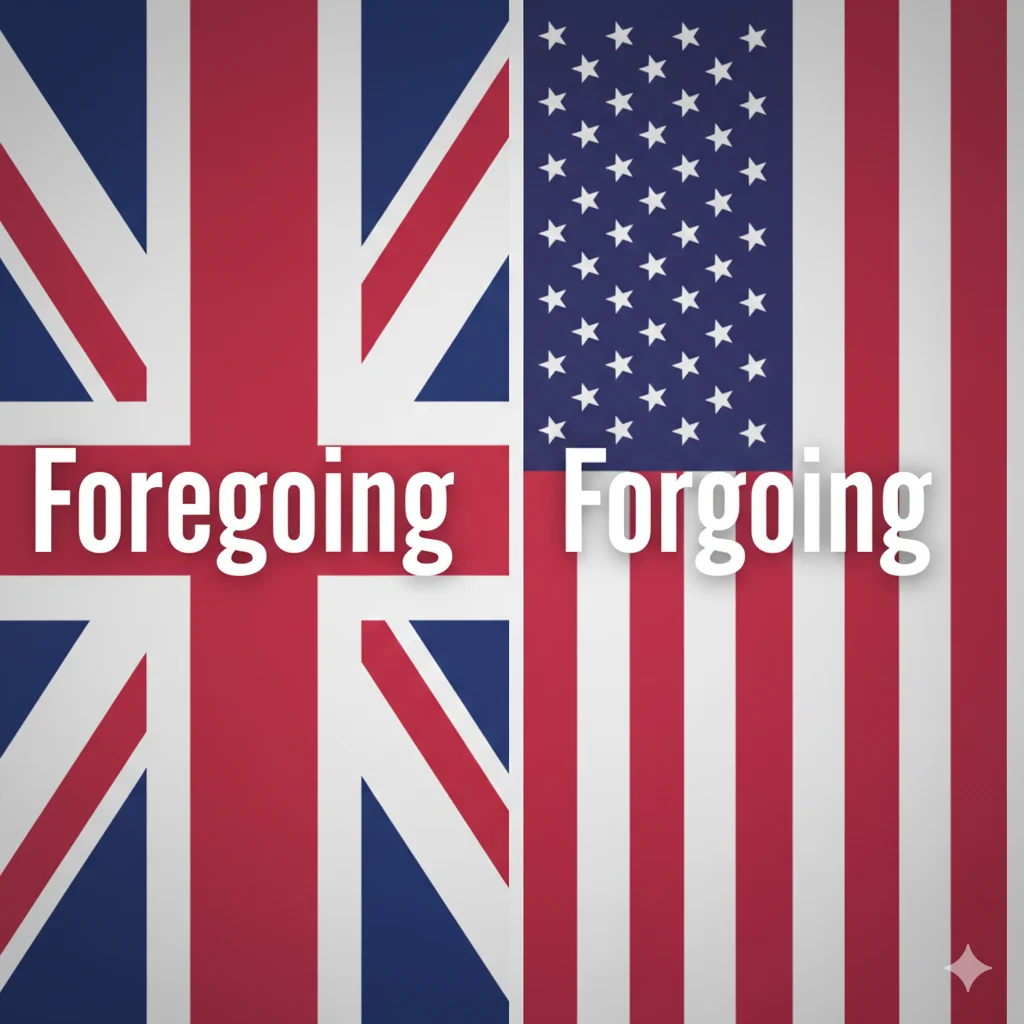
Here’s where it gets interesting. While the meanings are distinct, American English has simplified the spelling of the verb.
- British English: Traditionally uses “forego” for both meanings, relying on context to tell if it means “to precede” or “to do without.” However, “forgo” for the verb is also accepted.
- American English: Strongly prefers “forgo” for the verb meaning “to give up.” “Forego” is reserved almost exclusively for the “preceding” meaning.
| Feature | Foregoing (with ‘e’) | Forgoing (no ‘e’) |
|---|---|---|
| Primary Meaning | Previously mentioned, preceding | Giving up, doing without |
| Part of Speech | Adjective, Noun | Verb (present participle) |
| Word Origin | Old English foregān (to go before) | Old English forgān (to pass over) |
| Common in US English | Yes, for “preceding” meaning | Yes, standard for “giving up” |
| Common in UK English | Yes, for both meanings | Increasingly common for “giving up” |
Shower or Bath: The Complete Guide to Usage, Meaning & Spelling
Which Spelling Should You Use?
- For US Audiences: Use “forgoing” when you mean “giving up.” Use “foregoing” for “mentioned before.” This is the safest, clearest choice.
- For UK/Commonwealth Audiences: “Foregoing” is still widely understood for both. However, using “forgoing” for the verb is precise and avoids ambiguity, making it the better choice for clarity.
- For Global/Formal Writing: Adopt the US distinction. It is the most precise method and minimizes the chance of misunderstanding in international business, legal, or academic contexts.
Common Mistakes with Foregoing or Forgoing
The most frequent error is using “foregoing” when you mean the act of giving something up.
- Incorrect: “I am foregoing my bonus this year.” (Unless your bonus happened earlier in time, this is wrong).
- Correct: “I am forgoing my bonus this year.” (You are choosing to do without it).
- Incorrect: “The forgoing arguments are strong.” (This misspells the adjective).
- Correct: “The foregoing arguments are strong.” (The arguments mentioned before are strong).
Remember, the opposite of foregoing (as an adjective) is “following.” The opposite of forgoing (the verb) is “indulging in” or “taking.”
Foregoing or Forgoing in Everyday Examples
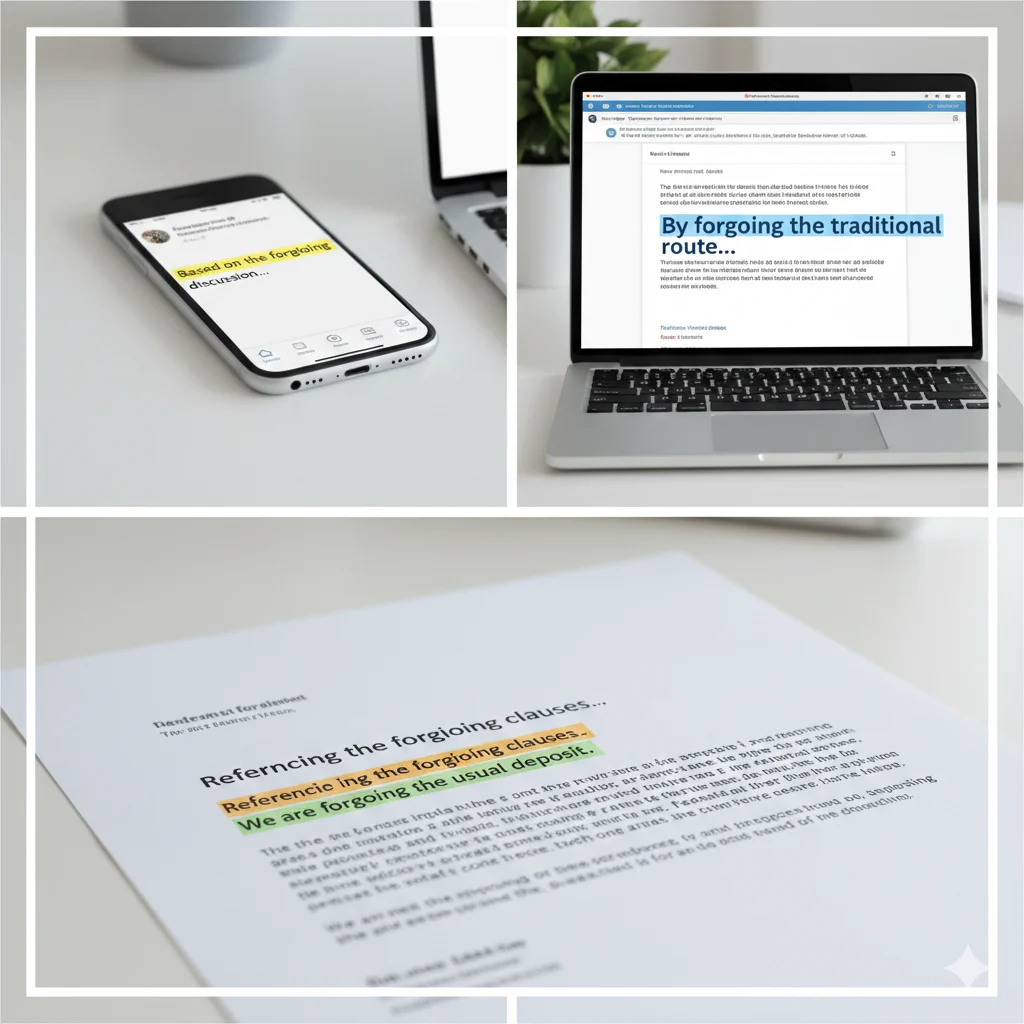
- Email: “Thank you for your email. Based on the foregoing points, we will proceed.” / “I will be forgoing the team lunch due to a prior commitment.”
- News Headline: “City Council, Forgoing Traditional Debate, Votes on New Zoning Law.”
- Social Media: “Forgoing plastic bags for good! #SustainableLiving.”
- Formal/ Legal Writing: “The foregoing agreement constitutes the entire understanding between the parties.”
Foregoing or Forgoing – Google Trends & Usage Data
Online search data shows that “foregoing” is searched slightly more often globally, likely because it is the standard adjectival form. However, searches for “forgoing meaning” are very common, indicating user confusion.
In the United States, the search interest for “forgoing” is proportionally higher, reflecting its status as the standard verb spelling. The data confirms that people are actively seeking clarity on this precise grammatical issue.
FAQs on Foregoing and Forgoing
1. What is the difference between foregoing and forgoing?
“Foregoing” refers to something mentioned before. “Forgoing” means voluntarily giving something up.
2. What does “foregoing” mean?
It means “preceding” or “previously stated.” Example: “The foregoing statement is true.”
3. Is forgoing a word?
Yes, absolutely. “Forgoing” is the correct present participle of the verb “forgo,” meaning to abstain from.
4. What is the difference between preceding and foregoing?
They are synonyms as adjectives. However, “foregoing” is used almost exclusively for things stated earlier in the same text, while “preceding” can refer to anything that came before in any context (time, sequence, place).
5. How to use forgoing?
Use it as a verb to show someone is choosing to skip something. Example: “He is forgoing a salary increase to invest in the company.”
6. Can you give more foregoing or forgoing examples?
- Foregoing: “The foregoing chapters set the scene.”
- Forgoing: “Forgoing caffeine improved her sleep.”
7. What is a good foregoing in a sentence example?
“After reading the foregoing analysis, the committee made its decision.”
Conclusion
In summary, the choice between foregoing and forgoing hinges on meaning, not chance. Remember this simple rule: if it’s about something that came before in the text, include the ‘e’ (foregoing). If it’s about giving up or doing without, drop the ‘e’ (forgoing).
Adopting this distinction, especially favored in American English, is the key to precision and clarity in all your writing. By understanding their unique origins and applications—from formal reports to everyday emails—you can communicate with confidence. So, the next time you write, you can confidently avoid common mistakes and choose the right word, ensuring your message is understood exactly as you intend.