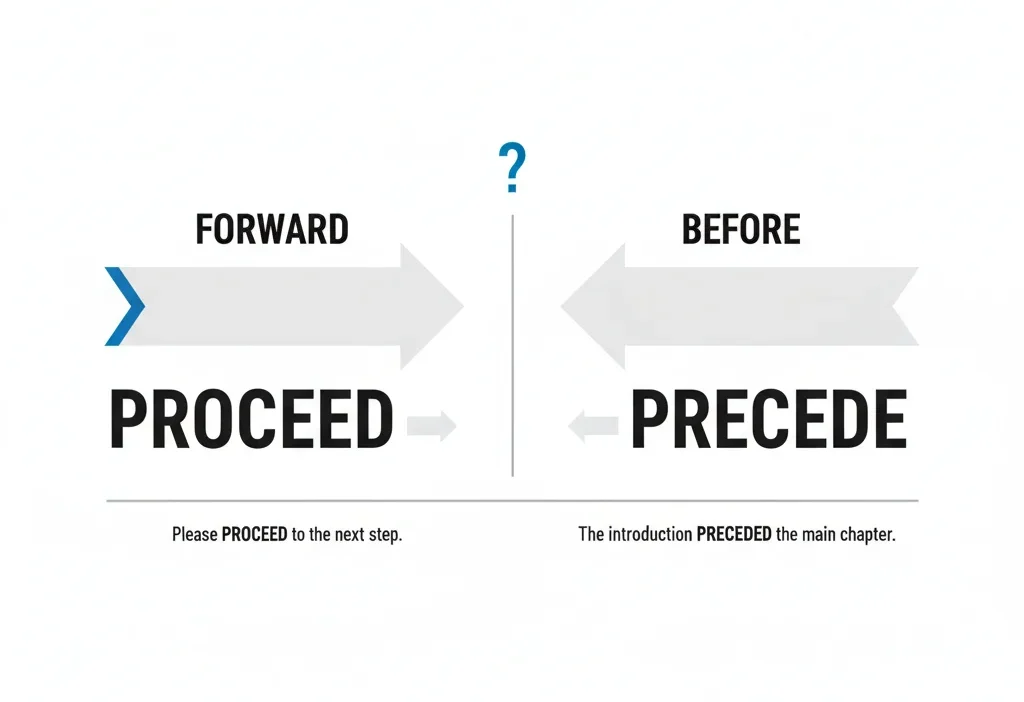
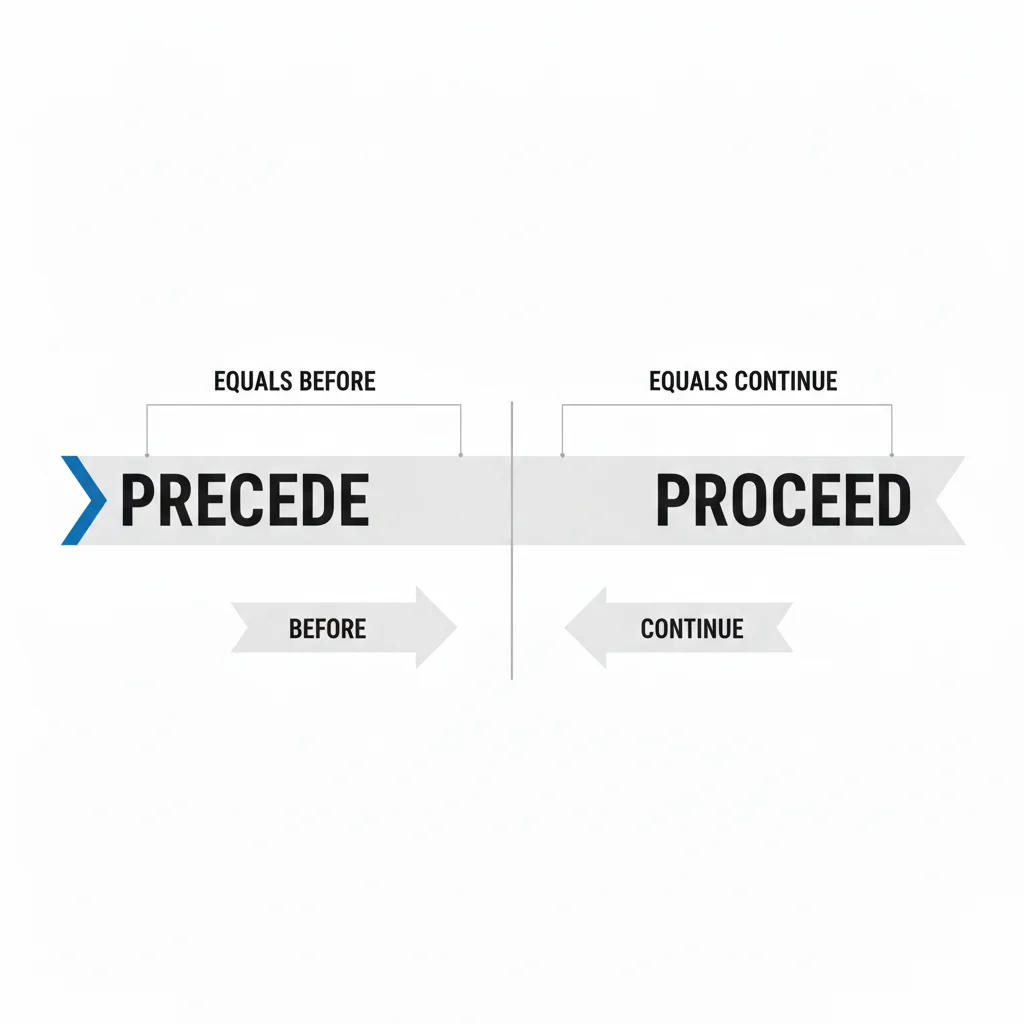
Proceed means to continue or move forward.
Precede means to come before something in time, order, or position.
The difference is simple:
👉 If something moves ahead → proceed.
👉 If something comes before → precede.
Confused between proceed and precede? You’re not alone. These two words look almost identical, sound similar, and are one of the most commonly mixed-up English word pairs online. One small spelling mistake can completely change your sentence meaning — and even hurt your writing credibility.
Here’s the trick you’ll never forget:
- Proceed = Continue (both have “ee”)
- Precede = Before (both have “e” before “e”)
Simple, right?
In this guide, you’ll learn the exact difference, easy memory tricks, real sentence examples, grammar rules, and common mistakes — so you never confuse them again.
Proceed or Precede means
Here is the simple rule:
- Precede = to come before something
- Proceed = to continue or move forward
Memory Trick
- Precede = Pre = Before
- Proceed = Pro = Forward
Quick Examples
- The introduction will precede the main discussion.
- After the break, we will proceed with the meeting.
If it happens first → precede.
If it continues → proceed.
This is the core proceed or precede difference.
The Origin of Proceed or Precede
Understanding word origin makes grammar easier.
Both words come from Latin.
Precede
From praecedere
- prae = before
- cedere = to go
Meaning: “to go before.”
Proceed
From procedere
- pro = forward
- cedere = to go
Meaning: “to go forward.”
The shared root (“cedere”) explains the spelling similarity. The prefix explains the meaning difference.
British English vs American English Spelling
There is no spelling difference between US and UK English.
| Word | US | UK | Meaning |
|---|---|---|---|
| Precede | Precede | Precede | Come before |
| Proceed | Proceed | Proceed | Continue forward |
The confusion is semantic, not regional.
Which Spelling Should You Use?
Choose based on function in the sentence.
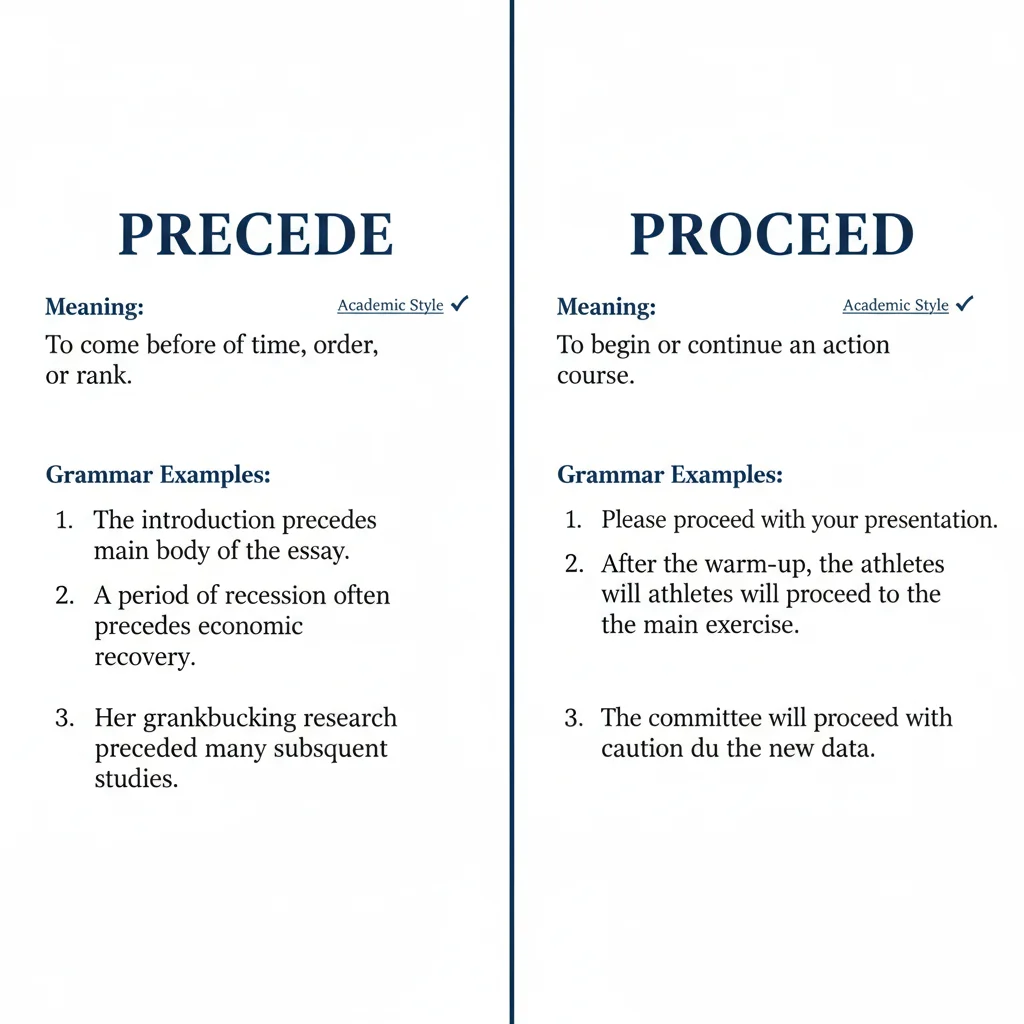
Use Precede When:
- Talking about sequence
- Describing order
- Writing historical timelines
- Structuring academic papers
Example:
- The abstract precedes the introduction.
Use Proceed When:
- Giving instructions
- Describing continuation
- Writing business emails
- Discussing legal procedures
Example:
- Please proceed with payment.
Proceed or Precede Grammar
1️⃣ Transitive vs Intransitive
- Precede is usually transitive (needs an object).
- The warning precedes the announcement.
- Proceed is usually intransitive.
- The meeting proceeded smoothly.
However, proceed commonly takes prepositions:
- Proceed with caution.
- Proceed to the next step.
2️⃣ Passive Voice Usage
- The ceremony was preceded by a speech.
- The trial was proceeded with caution.
Note: “Preceded by” is extremely common in formal writing.
3️⃣ Related Nouns
- Precedence = priority or importance
- Proceedings = legal or formal process
Example:
- Safety takes precedence.
- Court proceedings begin tomorrow.
These come from the same root but carry different meanings.
Common Mistakes with Proceed or Precede
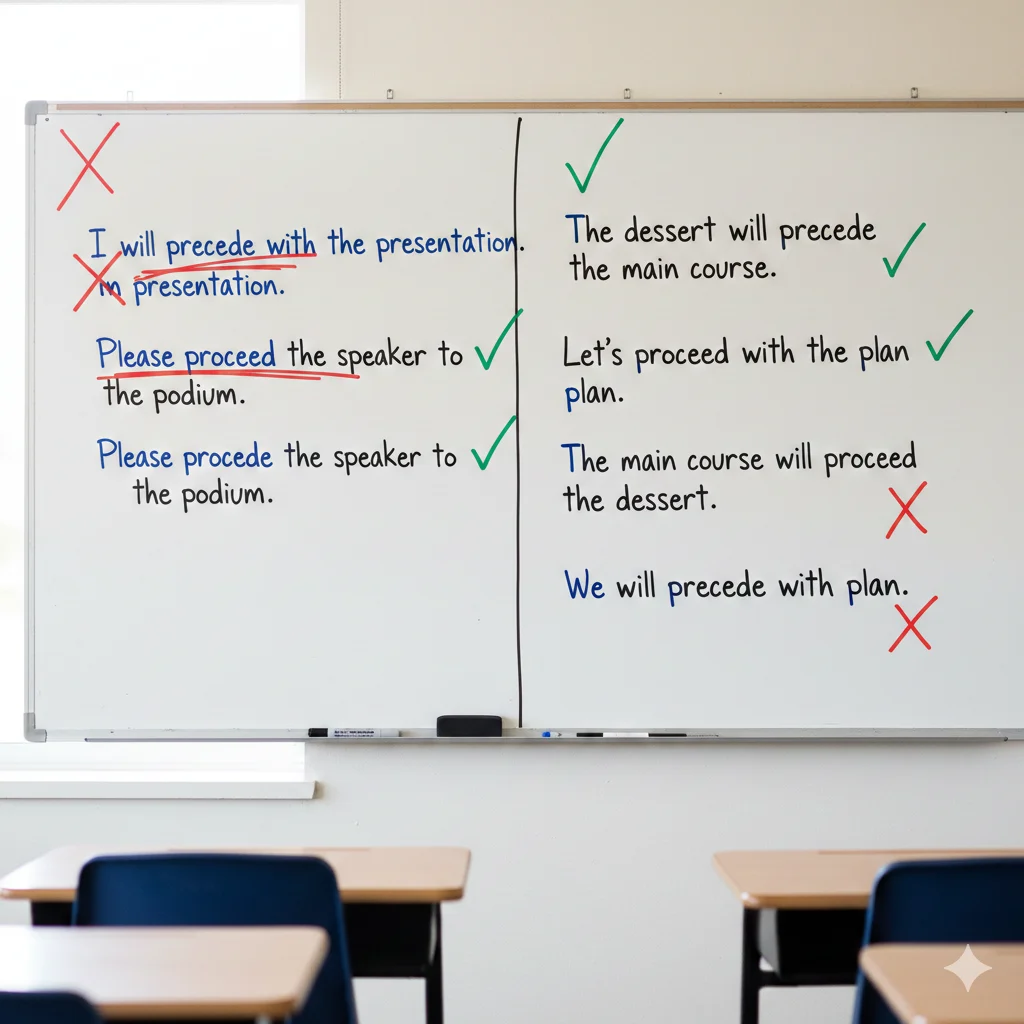
❌ Please precede to the next page.
✅ Please proceed to the next page.
❌ Dinner will proceed the awards ceremony.
✅ Dinner will precede the awards ceremony.
❌ The event preceded smoothly.
✅ The event proceeded smoothly.
Always ask:
Is it about order or continuation?
Proceed or Precede Difference (Complete Comparison Table)
| Feature | Precede | Proceed |
|---|---|---|
| Meaning | Come before | Continue forward |
| Prefix | Pre = Before | Pro = Forward |
| Grammar | Usually transitive | Usually intransitive |
| Example | Intro precedes chapter | Proceed with work |
| Related Noun | Precedence | Proceedings |
| Opposite | Follow | Stop |
Preceded vs Proceeded vs Succeeded
What is the difference between preceded and proceeded?
- Preceded = came before
- Proceeded = continued
Example:
- Rain preceded the storm.
- The meeting proceeded without delay.
What is the difference between preceded and succeeded?
- Preceded = came before
- Succeeded = came after
Example:
- Monday precedes Tuesday.
- Tuesday succeeds Monday.
Succeed vs Precede
Think of a timeline:
Precede → Event → Succeed
Precede = before
Succeed = after
This is a common exam question.
Proceed or Precede Meaning & Synonyms
Precede Synonyms
- Come before
- Lead
- Introduce
- Go ahead of
Opposite of precede: Follow
Proceed Synonyms
- Continue
- Advance
- Move forward
- Go ahead
Using synonyms improves writing clarity and avoids repetition.
Proceed or Precede in a Sentence (Real-World Examples)
Business Email
- Please proceed with the transaction.
- A confirmation email will precede the shipment.
Academic Writing
- The literature review precedes the analysis section.
- The experiment proceeded under supervision.
News Writing
- Heavy winds preceded the storm.
- Talks will proceed despite delays.
Legal Context
- The notice preceded the trial.
- The court will proceed with hearings.
Why Grammar Precision Matters
In academic and professional writing, precise verb selection:
- Improves clarity
- Reduces ambiguity
- Builds trust
- Signals expertise
Language experts agree that confusing similar verbs weakens authority.
Correct usage strengthens credibility.
Advanced Usage Clarifications
Can “precede” stand alone?
Rarely. It almost always refers to something specific.
Incorrect:
- The event preceded.
Correct:
- The event preceded the announcement.
Can “proceed” take an object directly?
Usually no.
Incorrect:
- Please proceed the payment.
Correct:
- Please proceed with the payment.
FAQs – Proceed or Precede
1. Is it proceed or precede to the next step?
Correct: Proceed to the next step.
2. When to use precede?
Use precede when something comes before another thing.
3. What is the opposite of precede?
Follow.
4. What is the difference between preceded and proceeded?
Preceded means came before. Proceeded means continued.
5. How do you use precede and proceed in a sentence?
Precede shows order. Proceed shows continuation.
6. Is precede formal?
Yes. It is common in academic writing.
7. Can proceed mean happen?
Yes. Example: The event proceeded without issue.
Final Conclusion
The difference between proceed or precede is simple but important.
- Precede = before
- Proceed = continue
If something comes first, use precede.
If something moves forward, use proceed.
Now you understand:
- Proceed or precede meaning
- Proceed or precede difference
- Grammar rules
- Preceded vs proceeded
- Succeed vs precede
- Opposite of precede
- Real-world usage
Correct grammar builds clarity.
Clarity builds authority.
Authority builds trust.
Next time you pause and ask, “Is it proceed or precede?” — you will know the answer instantly

-
“Rachel Cusk spins stories with wit and flair, sprinkling puns and clever twists in every line—write: to form words, sentences, or text—making reading joyful!”