Are you confused about teams or team’s? You are not alone. Many students, writers, and professionals pause when they type this word. Should there be an apostrophe? Is it plural? Is it possessive? A tiny punctuation mark can change the full meaning of your sentence.
If you searched “is it teams or team’s”, “teams or team’s grammar”, or “what is the difference between team’s and teams?”, this guide gives you a clear answer first, then a full explanation. It solves confusion about plural nouns, possessive nouns, apostrophe rules, and common grammar mistakes.
This article follows standard English grammar rules used in academic writing, journalism, business communication, and editorial style guides. It includes worksheets, quiz practice, comparison tables, expert tips, and real examples.
By the end, you will know:
- When to use teams
- When to use team’s
- When to use teams’
- How plural possessive grammar works
- How to avoid apostrophe errors in professional writing
Let’s start with the quick answer.
Teams or Team’s Difference
Here is the simple grammar rule:
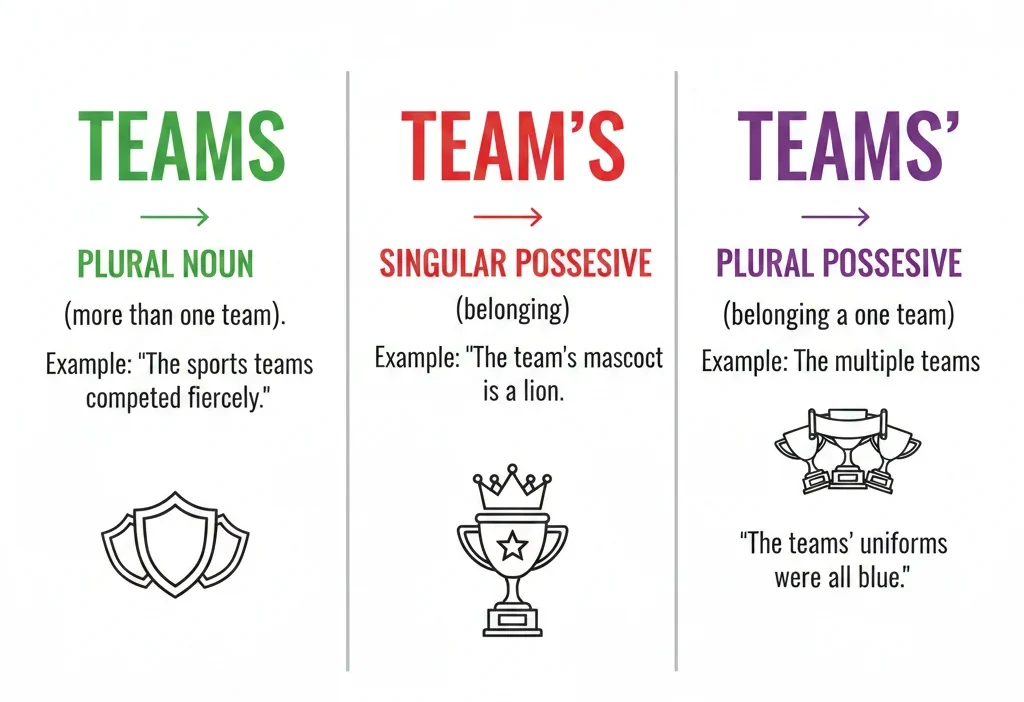
- Teams = plural form of team (more than one team)
- Team’s = singular possessive (something belongs to one team)
- Teams’ = plural possessive (something belongs to many teams)
Clear Examples
- The teams are ready. ✅
- The team’s coach is speaking. ✅
- The teams’ uniforms are clean. ✅
If you ask, “Is teams grammatically correct?”
Yes. It is correct when used as a plural noun.
If you ask, “When to use an apostrophe in teams?”
Use an apostrophe only to show possession.
Definition Box (Snippet Ready):
Teams is the plural form of team.
Team’s shows possession for one team.
Teams’ shows possession for multiple teams.
Apostrophes indicate ownership, not plural form.

Teams or Team’s Meaning
Understanding meaning makes grammar simple.
- Teams → more than one team
- Team’s → something belongs to one team
- Teams’ → something belongs to many teams
Example:
- Our teams won the tournament.
- Our team’s strategy worked perfectly.
- Our teams’ efforts impressed the judges.
If you search “teams efforts or teams efforts”, the correct form is:
- One team → team’s effort
- Many teams → teams’ efforts
This is called the plural possessive rule in English grammar.
The Origin of Teams or Team’s
The word team comes from Old English tēam, meaning group, family, or lineage. Over time, English grammar developed clear rules for:
- Plural nouns
- Possessive nouns
- Apostrophe punctuation
Modern grammar separates:
- Number (singular vs plural)
- Ownership (possessive form)
That is why we have three forms:
- team
- teams
- team’s
- teams’
This structure follows standard punctuation rules taught in schools and used in academic writing.
British English vs American English Spelling
There is no spelling difference between British and American English for teams or team’s.
However, collective noun agreement differs slightly.
In American English:
- The team is winning.
In British English:
- The team are winning.
This is called collective noun agreement. But the apostrophe rule stays the same in both styles.
Comparison Table
| Form | Grammar Type | Example | US English | UK English |
|---|---|---|---|---|
| Team | Singular noun | The team is ready. | ✅ | ✅ |
| Teams | Plural noun | The teams are ready. | ✅ | ✅ |
| Team’s | Singular possessive | The team’s captain | ✅ | ✅ |
| Teams’ | Plural possessive | The teams’ scores | ✅ | ✅ |
The rule works globally in academic and professional writing.
Which Spelling Should You Use?
Ask two questions:
- Is it singular or plural?
- Does it show ownership?
Use “teams” if:
You mean more than one team.
Example:
- Your teams performed well.
Use “team’s” if:
Something belongs to one team.
Example:
- Your team’s performance improved.
Use “teams’” if:
Something belongs to many teams.
Example:
- The teams’ responsibilities are listed below.
If you are unsure about your teams or team’s or our teams or team’s, check if ownership exists.
Common Mistakes with Teams or Team’s
Here are frequent grammar errors found in emails, essays, and news writing:
❌ Teams strategy
✅ Team’s strategy
❌ Teams efforts
✅ Teams’ efforts
❌ Teams’s coach
✅ Team’s coach
❌ Is it teams time?
✅ Is it team’s time? (one team)
✅ Is it teams’ time? (many teams)
Most confusion happens with teams plural possessive.
Remember:
Plural noun ending in s + apostrophe → teams’
Teams or Team’s in Everyday Examples
In Emails
- The team’s meeting starts at 3 PM.
- All teams must submit reports.
- The teams’ feedback was valuable.
In News Writing
- The team’s victory shocked fans.
- The teams’ scores were close.
In Business Contracts
- The team’s responsibilities are defined in section two.
- The teams’ obligations must be met.
In Academic Writing
- The team’s research supports the hypothesis.
- The teams’ findings were compared.
These examples improve clarity in professional communication.
Teams or Team’s Worksheet Practice
Fill in the blanks:
- The _____ captain thanked supporters.
- Our _____ uniforms were redesigned.
- The _____ strategy changed mid-game.
Answers:
- team’s
- teams’
- team’s
This works as a quick teams or team’s quiz for classroom learning.
Teams or Team’s – Google Trends & Usage Data
Search data shows strong interest in:
- is it teams or team’s
- teams or team’s grammar
- what is the difference between team’s and teams
- teams plural possessive
Search spikes usually happen during:
- School exam seasons
- ESL grammar lessons
- Sports tournaments
- Business writing tasks
Countries with high search volume include:
- United States
- United Kingdom
- India
- Canada
- Australia
Most errors come from misunderstanding plural possessive punctuation rules.
Full Comparison Table – All Forms Side by Side
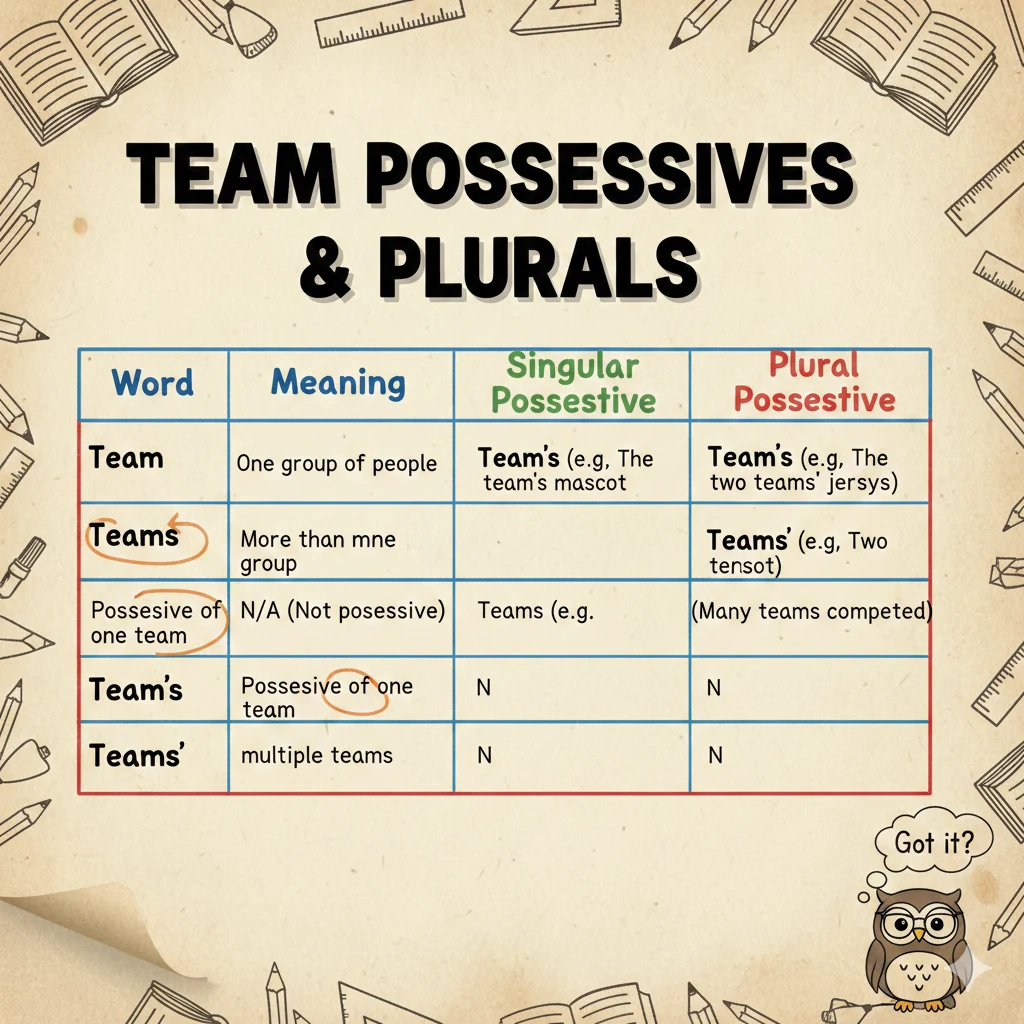
| Word Form | Type | Meaning | Example |
|---|---|---|---|
| Team | Singular | One group | The team is ready. |
| Teams | Plural | More than one group | The teams are ready. |
| Team’s | Singular possessive | Belongs to one team | The team’s coach smiled. |
| Teams’ | Plural possessive | Belongs to many teams | The teams’ fans cheered. |
If you ask, “teams or team’s or teams’?”, check number and ownership first.

FAQs
1. What is the difference between team’s and teams?
Team’s shows possession of one team. Teams means more than one team.
2. Is it team’s time or teams time?
Correct forms:
- Team’s time (one team)
- Teams’ time (many teams)
3. Is teams grammatically correct?
Yes. It is correct as a plural noun.
4. What is teams plural possessive?
Teams’ is the plural possessive form.
5. When to use an apostrophe in teams?
Use an apostrophe only to show ownership.
6. Is it your teams or team’s?
- Your teams (plural)
- Your team’s coach (one team owns something)
7. How can I avoid apostrophe mistakes?
Check meaning first. If ownership exists, use apostrophe. If not, use plural form only.
Expert Writing Insight
Professional grammar standards used in academic and editorial writing clearly separate plural nouns from possessive nouns. Apostrophes never make words plural. They show ownership.
In journalism, business communication, and academic research, punctuation accuracy builds credibility. Even small apostrophe errors can reduce trust in professional documents.
Editors often recommend reading the sentence using:
- “of the team” → team’s
- “of the teams” → teams’
This quick substitution test prevents errors.
Conclusion
The confusion between teams or team’s is common but easy to solve. The difference depends on number and ownership.
- Teams = plural noun
- Team’s = one team owns something
- Teams’ = many teams own something
Apostrophes show possession, not plural form. This rule applies in emails, news articles, business reports, academic papers, and social media posts.
Clear grammar improves professionalism, authority, and readability. When you understand plural possessive rules, you write with more confidence and clarity.
Now, if someone asks, “Is it teams or team’s?”, you can explain the rule clearly and correctly.
Practice with worksheets and quizzes until the rule becomes natural. Strong grammar builds strong communication.

-
“Ali Smith weaves puns like magic, sprinkling humor and wit in every line. Guaranteed to make your day a little brighter!”